

In today's industrial production and commercial fields, paste filling machines play a vital role, especially in the cosmetics, food, medicine, chemical and other industries, where they can be seen everywhere. It can accurately and efficiently fill various paste products, such as creams, jams, ointments, glues, etc. into predetermined containers, ensuring the quality of the products and the consistency of packaging, and meeting the market's large demand for various paste products.
Types and characteristics of paste filling machines
Paste filling machines can be mainly divided into semi-automatic paste filling machines and fully automatic paste filling machines according to the degree of automation and working principle.
Semi-automatic paste filling machines usually have the characteristics of simple structure, convenient operation and relatively low price, which are suitable for small enterprises or small production scales and limited budgets. It generally requires manual assistance for the placement and removal of containers, but it can achieve certain precision requirements in the control of the filling volume. By manually adjusting the stroke of the filling valve or piston, it can realize the filling of products of different capacities, with high flexibility.
Fully automatic paste filling machines represent higher production efficiency and intelligence. It can automatically complete a series of operations such as container conveying, positioning, filling, and sealing, without a lot of manual intervention, greatly improving production speed and output. The use of advanced metering systems, such as peristaltic pumps, piston pumps or gear pumps, combined with high-precision sensors and control systems, ensures that the dosage of each filling is accurate and the error is minimal, which can meet the needs of large-scale and high-precision production and is widely used in modern production lines of large enterprises.
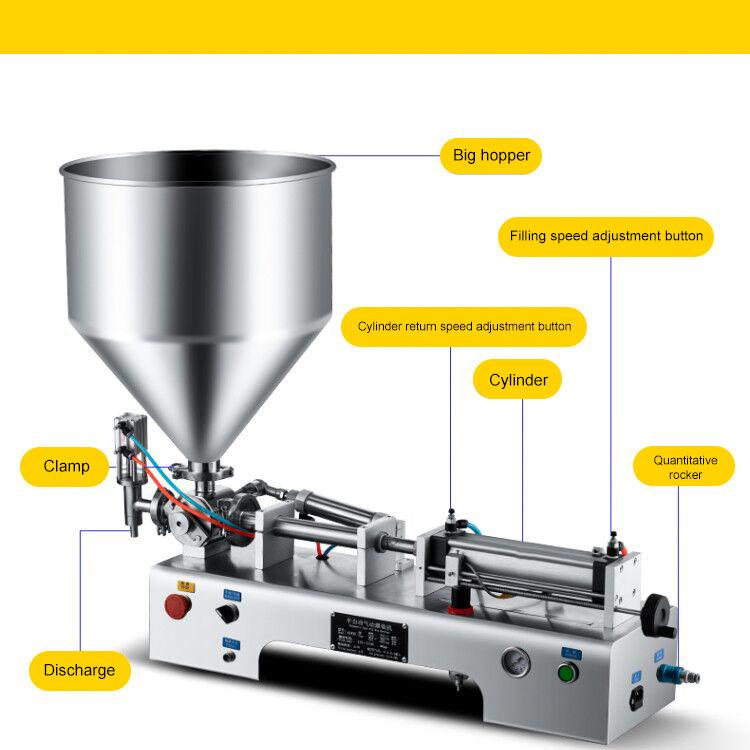
In addition, according to the characteristics of the filled paste, the paste filling machine can also be divided into ordinary paste filling machines and special paste filling machines. For some pastes with special properties such as high viscosity, containing particles or easy to foam, the special paste filling machine can effectively overcome these difficulties through special designs, such as the use of special filling head structures, stirring devices or vacuum systems, etc., to ensure the smooth progress of the filling process and the quality of the product is not affected.
How to use the manual paste liquid filling machine
For some small production needs or laboratories, manual workshops and other scenes, the manual paste liquid filling machine is an economical and practical choice. The following are the basic steps for using a manual paste liquid filling machine:
(1) Preparation
Before use, first ensure that the filling machine is clean and hygienic. Disassemble the various components of the filling machine, clean them with clean water or appropriate detergent, and then dry or wipe them dry to prevent impurities from mixing into the paste product and affecting product quality.
Select a suitable filling head and piston according to the characteristics of the paste product to be filled and the required filling volume. For example, for thicker pastes, you may need to choose a filling head with a larger aperture and a piston with a stronger thrust to ensure smooth filling; for small-dose, high-precision filling requirements, you should choose a filling component with higher precision and smaller aperture.
Place the filling machine on a stable workbench and ensure that the surrounding environment is clean to avoid dust, debris, etc. from interfering with the filling process.
(2) Installation and debugging
Install the cleaned and dried filling components back onto the filling machine, paying attention to the firmness and sealing of the installation to prevent paste leakage.
Adjust the filling volume of the filling machine. Generally speaking, manual paste liquid filling machines control the filling volume by rotating the adjustment knob or moving the position of the piston. You can first conduct a small amount of trial filling, use a measuring cylinder or electronic scale to measure the filling volume, and then make fine adjustments based on the measurement results until the required precise filling volume is reached.
Check whether the various connection parts of the filling machine are tight, such as the connection between the hopper and the filling component, the fitting between the piston and the cylinder, etc., to ensure that there is no looseness or leakage.
(3) Filling operation
Pour the paste product to be filled into the hopper of the filling machine, and be careful not to exceed the maximum capacity of the hopper to prevent the paste from overflowing. At the same time, ensure that the paste has good fluidity. If the paste is too viscous or contains too many bubbles, it may affect the accuracy and smoothness of the filling. The paste can be properly stirred or heated to improve its fluidity.
Pick up the container to be filled and place it under the filling port of the filling machine, ensuring that the container port and the filling port are tightly connected to avoid the paste from splashing. Then, slowly push or pull the operating handle of the filling machine to move the piston and pour the paste into the container at a uniform speed. During the filling process, maintain smooth and consistent operation to avoid speeding up and slowing down to avoid errors in the filling volume.
When the set filling volume is reached, stop the movement of the operating handle immediately, remove the filled container, and place it aside for subsequent sealing, labeling, etc. Then, continue the filling operation of the next container and repeat the above steps until all containers are filled.
(4) Cleaning and maintenance
After completing the filling task, clean the filling machine in time. Clean the remaining paste in the hopper to prevent the paste from drying inside the hopper and affecting the next use. At the same time, disassemble the filling parts again, clean them thoroughly with detergent, and wipe or dry them and store them properly.
Regularly inspect and maintain the various components of the filling machine, such as checking the wear of the piston, the sealing of the seal, the smoothness of the filling head, etc. If any damaged or severely worn parts are found, they should be replaced in time to ensure the normal operation and filling accuracy of the filling machine.
Advantages and application prospects of paste filling machines
The emergence and wide application of paste filling machines have brought many significant advantages to many industries.
In terms of production efficiency, whether it is semi-automatic or fully automatic paste filling machines, they can greatly improve the filling speed. Compared with the traditional manual filling method, they can complete the packaging of a large number of products in a short time, meet the market's demand for rapid supply of products, enable enterprises to better adapt to the fierce market competition environment, and improve production efficiency and economic benefits.
In terms of product quality control, the paste filling machine, with its precise metering system and stable filling performance, can ensure the consistent filling volume of each bottle and bag of paste products, avoiding quality problems such as excessive product weight difference, paste overflow or insufficient filling caused by the instability of manual operation, improving the overall quality level of the product, enhancing consumers' trust and satisfaction with the product, and helping the company to establish a good brand image.
With the continuous advancement of science and technology and the continuous development of various industries, the application prospects of paste filling machines are becoming more and more broad.
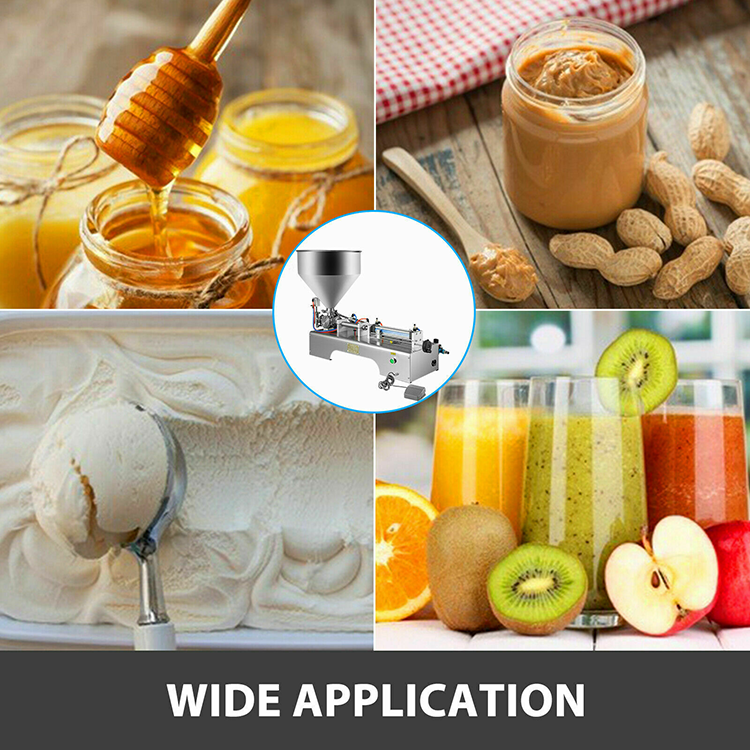
(1) In the cosmetics industry, with the continuous growth of consumer demand for beauty and skin care products, paste filling machines will provide strong support for the large-scale production of various creams, lotions, masks and other products;
In the food industry, the packaging of paste foods such as jams, meat sauces, and seasoning sauces is also inseparable from the efficient operation of paste filling machines;
(2) In the pharmaceutical industry, the precise filling of ointments, gels and other drugs is related to the safety of patients' medication and treatment effects. The importance of paste filling machines is self-evident.
(3) In the fields of chemical industry, electronics, etc., paste filling machines also play an indispensable role in the production and packaging of various adhesives, lubricants, electronic pastes and other products.
As one of the indispensable equipment in modern industrial production, paste filling machines, with their high efficiency, precision and stable performance characteristics, have brought revolutionary changes to the production and packaging of paste products in various industries, and promoted the rapid development of related industries. In the future development, with the continuous innovation of technology and the further expansion of application fields, paste filling machines will continue to play their important role and create greater value for more enterprises.

อีเมล : Molly@xmlk-machine.com
ส่งอีเมลถึงเรา
Room 810, No. 35-2 Xinjing Road, Haicang, Xiamen, Fujian, China
ที่อยู่ของเรา
โทร : +86 18150150881
Whatsapp : +8618150150881
โทรหาเรา


 ไทย
 English
 français
 português
